By ViGo
Table of Contents
Introduction
Thoughts and emotions are part of our life, and it is essential that we take special care in how we relate to them. Understanding thoughts and emotions should not create extra, unnecessary thoughts or emotions, because thoughts and emotions are required for life.
What is their nature? When the nature of thoughts and emotions is understood, a neutral state about it can be established. A neutral state, in the sense that there is no resistance when emotions arise, nor uncontrolled loose emotions, nor suppression. In the same way about thoughts: there is no hesitation to think. There is wisdom which guides you in what to think. In that way, life can flow in a middle path, a balanced expression of life through thoughts and emotions.
We will explore this further; understanding the nature of thoughts and emotions, how life manifests through them. When they become tools, when they become traps, and how to bring clarity and balance into inner life.
The two dimensions of life expression
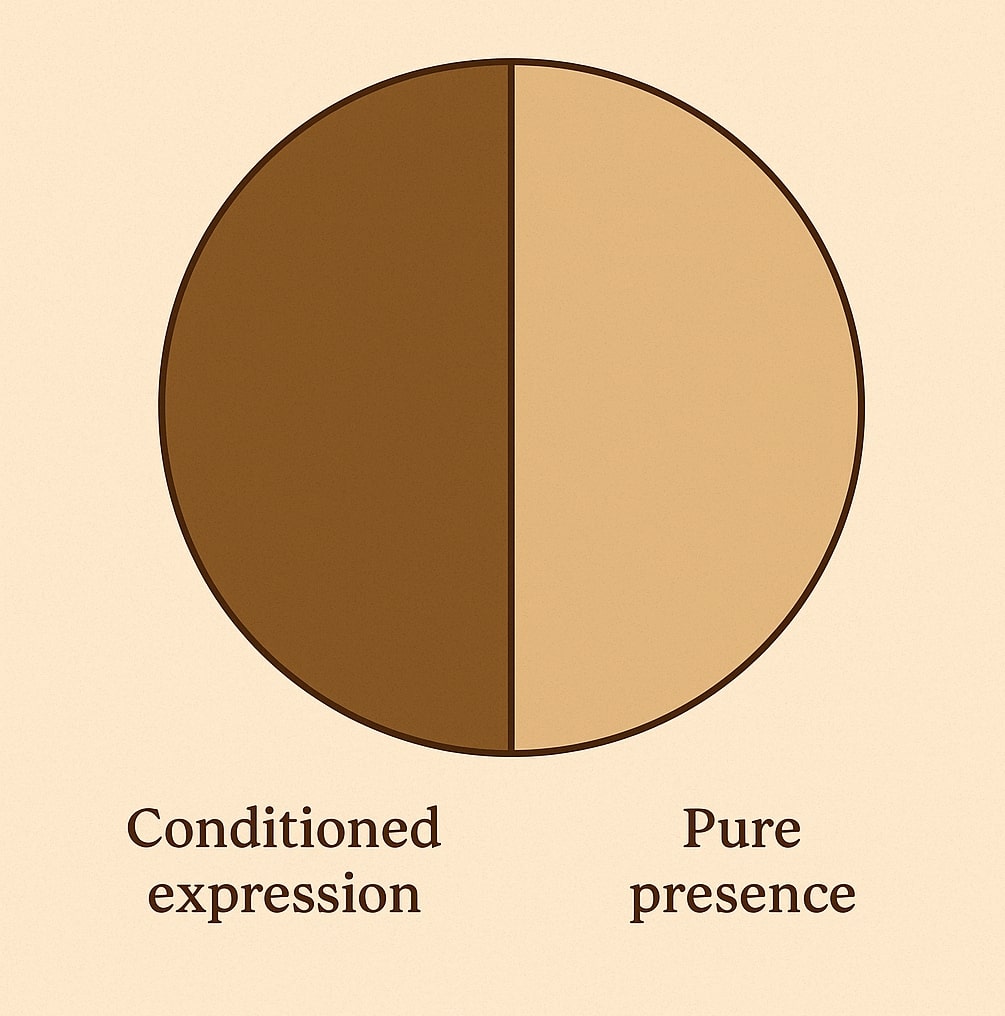
Life, when considered as life, manifests in two dimensions. One dimension is shaped by our imprints, by the past. As per our past conditionings, experiences, and habits, life expresses through that imprint. This is one way life manifests.
At the same time, there is another dimension of manifestation, a dimension where there is no question of past or future. It is an unconditional manifestation of life. This is the pure, wisdom‑oriented manifestation of consciousness into nature. When one reads the classical texts, or when one truly understands and experiences that dimension, one reaches a pure state of consciousness.
In that state of consciousness, nature reflects itself through you. There is no one sitting inside: no ego, no past imprints, no prejudices, no expectations. There is no conditional interference when you express your life. This pure form of life is a state where there are no unnecessary emotions, no unnecessary thoughts, nothing extra.
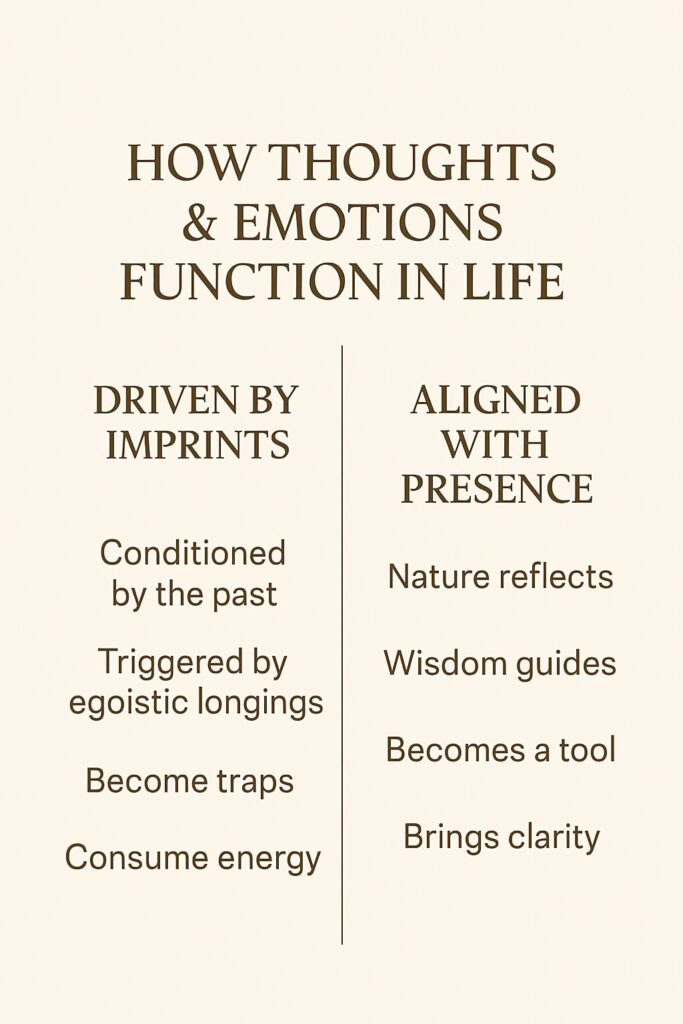
Thoughts and emotions remain, but they become tools of life. They are not burdens, not reactions. In that state, thoughts and emotions reflect the true Self. Emotions represent the egoless state, they manifest the real state of your being.
So when life is expressed in that way, with clarity, in presence, thoughts and emotions become “decorative” ingredients. They add spice, colour, flavour to life, but they do not dominate, they do not lead you away from your true Self.
When thoughts and emotions become traps
Many times, thoughts and emotions arise from the past, from desire, from fear, from imprints, not from presence.
The mind starts believing: I wanted something from life which I am not getting, that’s why I am emotional; I am too disturbed, that’s why I am thinking a lot.
In that mindset, one starts to hold the illusion that by thinking a lot one can solve something, conclude something, reach somewhere. This is an ignorant way of handling the Citta (mind).
People often think about things they don’t have control over. For example: somebody from the Netherlands may be reading this blog. They know it is very cold there or it might get colder tomorrow. If you worry thinking “tomorrow will be very cold,” what do you get out of it? You may have many thoughts, but the situation is not in your control.
Here is the principle: thoughts should be aligned between two directions, one is planning, and the other is worrying about what is beyond your control. Planning is okay, it means using thoughts for what you can do, for what is in your domain of responsibility or possibility. But worrying, thinking about things you can’t control, that drains your energy pointlessly.
Because by thinking we lose a lot of energy, the mind is always running. Compare it to the physical: where the body runs ahead, thought runs into the future. That strains many people, we spend energy on what is not needed.
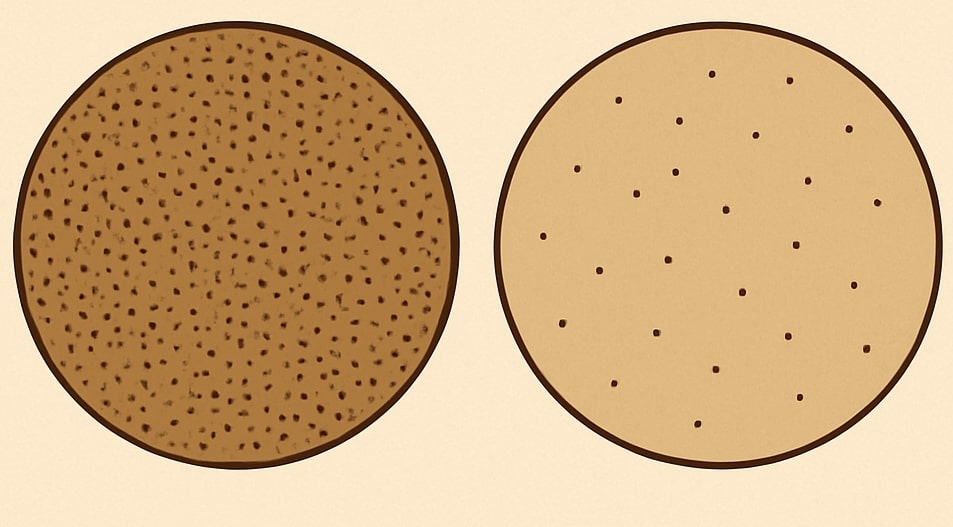
Often it is said that a human being may have around 60.000 thoughts per day, a huge number. Whereas something around 300–400 thoughts in a day might be more than enough. See the huge gap. If you manage to save that energy, the quality of life changes directly. Suddenly you begin to feel more space inside. The space that was continuously occupied by thoughts becomes empty, for your true Self to express.
Because every thought is about something else, something outside you. That means you are failing to live your own life, you become someone living in reactions.
Therefore, you should become very miserly in thinking. Miserly in thinking does not mean you stop thinking, it means you know when to use the extraordinary gift of thinking. Not all thoughts are useful, not all are needed.
Thinking in itself is a gift. Through thinking, humans can express life in complexity, build civilisations, create art, language, and science. If you organise thinking as per the nature of life, it becomes a beautiful gift. But if you misuse it, if you always think about what you don’t control, your own emotions, your own thoughts, it will consume your life.
Hence we need to be careful. We need to discriminate between what arises out of imprint and what arises out of presence. Between habitual reaction and conscious expression.
Such awareness reveals how thoughts and emotions guide, or misguide, our life, and shows why so many thoughts arise.
Why so many thoughts?
Why do people have so many thoughts? Mainly because a strong pattern has been created in life. We are constantly fed by education, by parents, by society, by our job, everywhere, with the idea that you must do something in order to go somewhere. That doing‑concept becomes a strong drive. Everywhere we are conditioned to think, plan, act, and achieve.
When the doing-concept is associated with effort, naturally thoughts come. Because doing becomes linked with thinking, analysing, reasoning, organising; to manage, to control, to improve.
Yes, doing is required, we must act in life, we must work, live responsibly, and contribute. But often we act with our mind in effort mode, thinking, planning, and worrying. Not from presence, but from habit.
We need to understand the limits of our doing, we cannot assume we are limitless. We cannot hold the moon, the sun, the sky. There is a limitation to what we can do. Recognising that limitation brings pleasantness, a natural contentment arises. When contentment guides your actions, the mind becomes quieter. Thoughts happen only when needed.
Otherwise life becomes chasing a rat we cannot catch, endlessly.
The middle path: presence, simplicity, balance
When we understand the nature of life and the nature of mind, life naturally becomes simple. Life is simple, complexity was created by us through thoughts, identification, logic, ego.
If life is simple, we may lose our false identity built through complexities. But we gain something far more precious: freedom, space, and presence.
When we accept what is, when we are ready to face anything, good or bad, without escape, without expectation, then true living begins.
Whatever comes, in our job, relationships, incidents, whether favourable or not, we face it. We don’t run away, we don’t avoid it. We don’t hold onto any idea, we know our limitations. We know what is possible, and we act within our capacity, aligned to truth.
When this understanding becomes part of the totality of knowing, when mind, body, action, and being come together, the thought process simplifies. The noise reduces, instead of being lost in countless thoughts, you begin to live from clarity, from depth, from your true Self.
In this way you can organise your thoughts, you can align emotions. You live what you truly are, not what your mind has programmed you to be.

Conclusion: living from presence, not from thought
Thoughts and emotions are neither enemies nor obstacles. They are part of life, required, useful, but they need to be handled wisely.
When you understand their nature, when you see the difference between imprint-based reactions and wisdom-based expressions, you can bring balance.
Be miserly with thinking, use the gift of mind consciously. Let thoughts serve your life expression, not dominate it. Let emotions reflect your true Self, not your egoic pains.
Live life from presence, live life from awareness. Let thoughts and emotions become tools of life, not traps of the mind.
When this happens, the inner space opens, the true Self expresses. Life becomes simple, clear, and real.


1 thought on “Understanding Thoughts and Emotions: A Yogic Perspective”
as i was sharing my ashram experiences with friends in the netherlands, it felt very natural to send them the link to these very clear Words…
Thank you!