
Table of Contents
Most of us come to Yoga through the body. We learn the postures, refine our alignment, and for a while that feels like enough. Then a subtler question begins to arise: what is all this practice for?
Pause with that question for a moment. It is an old one. Nearly two thousand years ago, Sage Patanjali answered it with precision in the Yoga Sutras. Yet for many practitioners and teachers, the Sutras remain a book on the shelf: honoured, sometimes quoted, trying to be read, but rarely lived.
The Patanjali Yoga Sutra Practical Course at Yoga Gita Ashram, near Mysore, is an invitation to live them. In the words of the ashram: ‘We will connect the timeless wisdom of the Patanjali Yoga Sutra directly to your personal Yoga practice on the mat and to your everyday life.’ What follows is not a list of promises, only a few reflections on how the Sutras, received in this way, can slowly change how you practise and live.
The Yoga Sutras: a revelation of your true Self
The Yoga Sutras are around 196 short aphorisms, gathered in four chapters, or pādas.
Sutras can be translated as aphorisms, but in reality it doesn’t touch the real deeper meaning of Sutras. What is Sutra? Why is Sutra required to express a truth which is experienced?
A subject presented completely in the minimum possible words without altering the depth of the subject is called Sutra. When you try to express a subject using more words than required, there is the danger that instead of expressing the truth it will end up as a collection of information, which may lead just to a learning process. By reading Patanjali Yoga Sutra the beauty of it is you learn to unlearn. You will become very pure. The sutras are not a text to obey, but a revelation of your true Self, the existence itself. It is only a pure experiential path.
At Yoga Gita, this text is received as a Science of Consciousness: Yoga As It Is. The intention is simple and honest: to decode the scripture into a clear, practical method that can be lived on the mat and in daily life.
Stability and being comfortable: when posture stabilises into a presence
Sthira-sukham āsanam (Yoga Sutra 2.46): ‘Posture should be stable and comfortable.’
This is almost all Patanjali says about posture. Stable (sthira) and comfortable (sukha) are held together, neither traded for the other. The following sutra shows the way: prayatna-śaithilyānanta-samāpattibhyām (2.47), posture ripens through the cessation of effort. Then what happens is the merging of the individual with the infinite, where no gap remains between you and existence; that gap is the struggling life.
ViGo teaches asana in the direction of effortlessness. When this sutra is experienced rather than memorised, you begin to notice where you grip, where you strain, where you perform, where you separate. The space that arises through the cessation of effort is where a touch of easiness begins to carry you, in the asana and in your life. The posture becomes a place to become aware of the subtlety and implications of effort on every level of your life.
Over time, as sutra 2.48 describes, tato dvandvānabhighātaḥ: the pairs of opposites, such as heat and cold or praise and blame, disturb you less, and duality is merged. This is not about stretching the body further; it is about allowing your being to unfold.
Where Yoga truly happens
Yogaś citta-vṛtti-nirodhaḥ (Yoga Sutra 1.2): ‘Yoga is the stilling of the fluctuations of the mind.’
Patanjali’s definition of Yoga does not mention the body at all. Yoga is the settling of the vṛttis, the movements of thought, memory, imagination and perception within chitta, the field of the mind. When those movements settle, sutra 1.3 tells us, tadā draṣṭuḥ svarūpe ‘vasthānam: ‘then the true Self will reveal itself in its pure form.’ Then the true Self, the drashtuh (seer) that we all carry within, is something you will be able to experience.
Let that sit for a moment. When it is understood from within, every practice takes on a different quality.
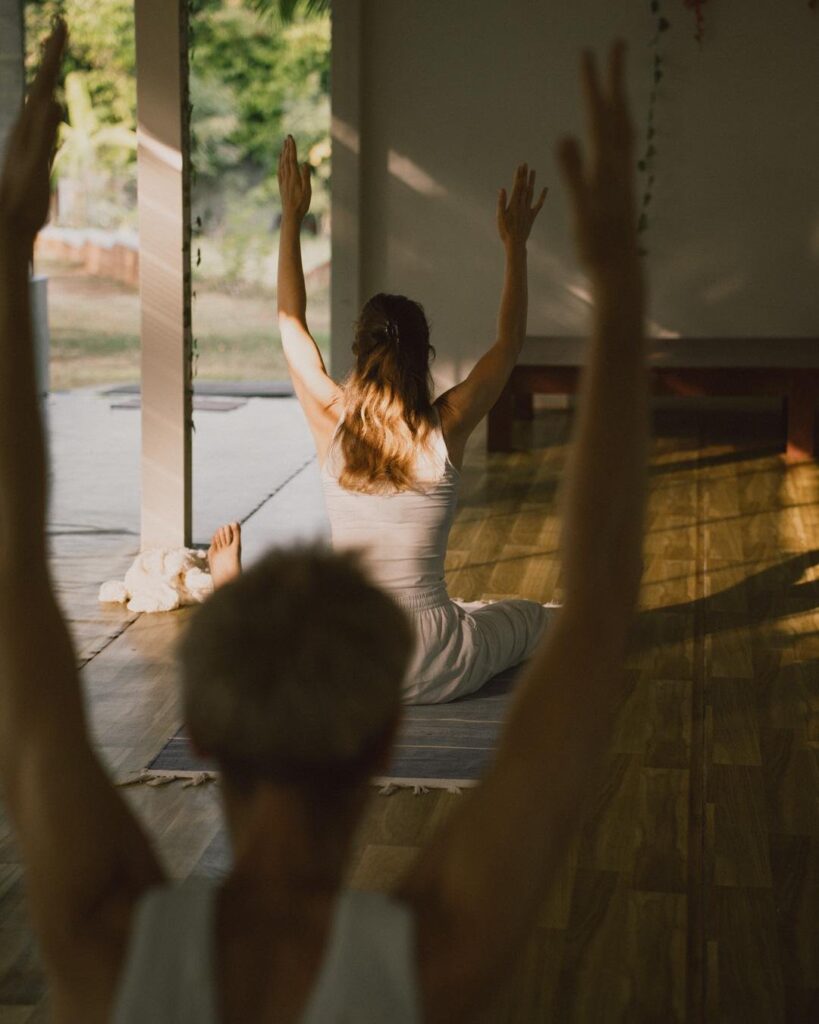
Practice and letting go
Abhyāsa-vairāgyābhyāṁ tan-nirodhaḥ (Yoga Sutra 1.12): ‘The fluctuations are stilled through practice and non-affectedness.’
Abhyāsa, stable practice, and vairāgya, non-affectedness, are two wings of one path. Patanjali adds that practice becomes firmly rooted when it is tended for a long time, without interruption and with sincere devotion (1.14).
There is no hurry in this. It asks only that you return, day after day, realising there is no particular result. In that rhythm, striving begins to dissolve, and something more lasting can take its place.
Living Yoga beyond the mat
The first two limbs or components of Yoga are about how we interact with the outer world and how we organise our ‘inner’ world on the path to Self-realisation.
The yamas (2.30):
- ahiṁsā: non-harming
- satya: truthfulness
- asteya: non-stealing
- brahmacarya: right use of energy
- aparigraha: non-possessiveness
The niyamas (2.32):
- śauca: purity
- santoṣa: contentment
- tapas: disciplined effort/wilfulness
- svādhyāya: self-study
- īśvara-praṇidhāna: surrender to the highest
Received in an ashram, these are not a list to recite but reflections to carry through the day. How does non-harming feel in a difficult pose? What does contentment feel like in a tense conversation? And how can I constantly be present in a state of pure Self reflection?
Asana within the eight limbs
Yama-niyamāsana-prāṇāyāma-pratyāhāra-dhāraṇā-dhyāna-samādhayo ‘ṣṭāv aṅgāni (Yoga Sutra 2.29). The eight limbs are:
- Yama: how you deal with yourself and your own life expression
- Niyama: how you interact with society
- āsana: posture
- Prāṇāyāma: connecting with prana, life energy
- Pratyāhāra: presence beyond sense perception, no longer influenced by the senses
- Dhāraṇā: oneness
- Dhyāna: meditation
- Samādhi: absorption
Asana is the third of eight limbs. It is neither the whole of Yoga nor something to set aside; it prepares the body so that breath, attention and awareness can deepen. For the practitioner, posture practice becomes a doorway to the subtler dimensions of Self.
At Yoga Gita, this inward journey is also understood through Pancha Kosha, the five sheaths of the Self, from the physical body through life energy (prana), mind and wisdom to bliss: a journey from the gross to the subtle.
From knowing about the Sutras to knowing them within
Reading about the Sutras gathers information. Living them awakens the wisdom that is already within you. On the course, each day holds approximately six hours of sessions, on and off the mat:
- Asana practice, pranayama and meditation
- Chanting and study of the Yoga Sutras of Sage Patanjali
- Life skills, self-reflection and group discussions
- Q&A sessions and individual and group activities
Every session is linked to, and understood through, the philosophy of the Sutras. You do not simply hear certain sutras explained; you play with them in the morning practice, reflect on them individually or together, and they are contemplated during meditation practices.
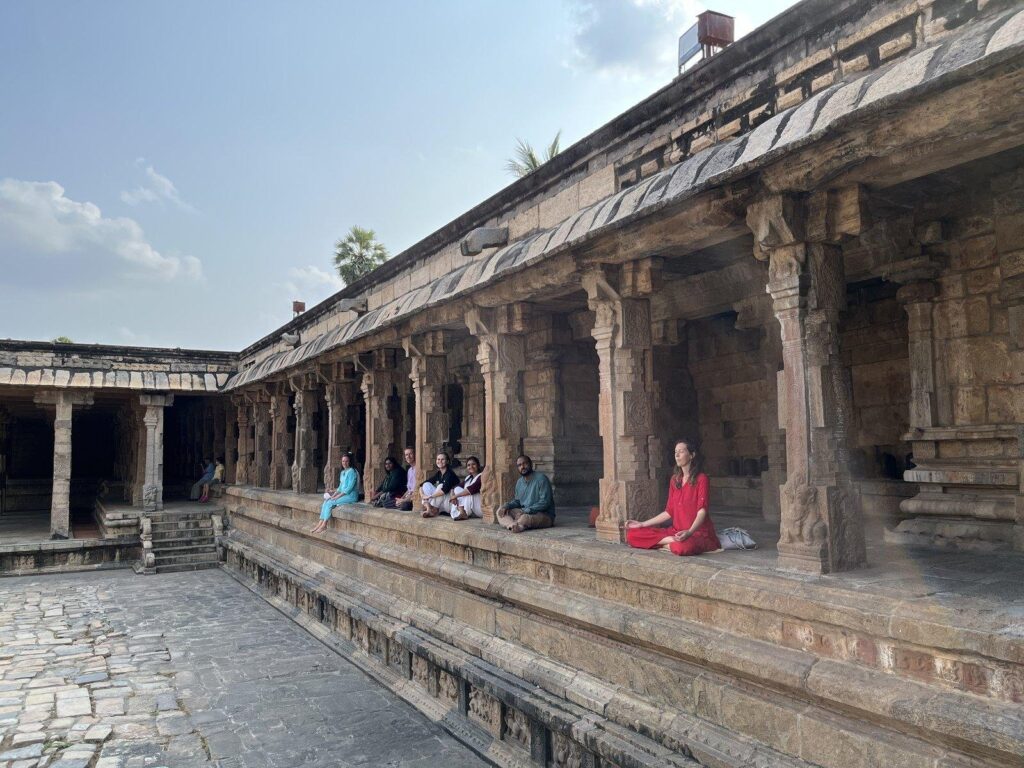
At the feet of a living teacher, by the Kaveri
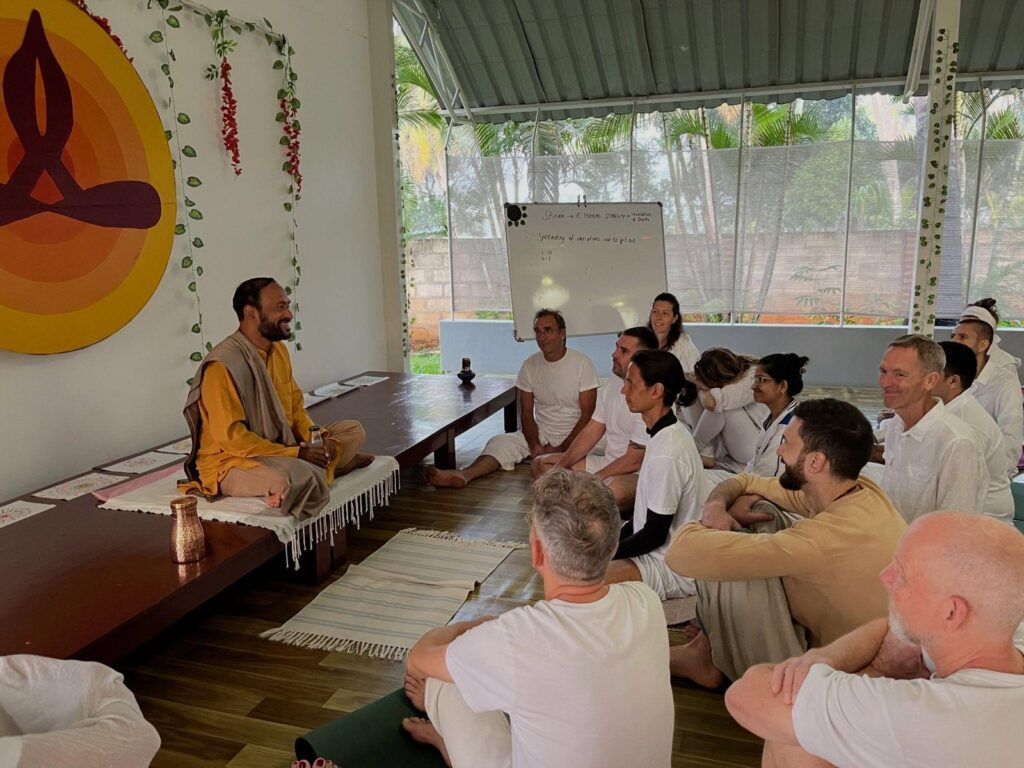
The Sutras have always been passed from teacher to student, in presence. This course continues that living transmission. Pranayama and Philosophy sessions are guided by ViGo (Sri Vijay Gopala), the founder and main teacher of Yoga Gita. Guided from a young age by his father, ViGo also holds two Master’s degrees, one in Philosophy and one in Yoga. Step by step, he brings ancient knowledge into contemporary language, so that it feels less like learning something new and more like recognising what is already within you. Much of what is received comes not through words but through silence and presence.
The course is fully residential at Yoga Gita Ashram, about nine kilometres north of Mysore on the banks of the Kaveri (Cauvery) River. The river, birdsongs and the garden hold a quiet in which the mind settles on its own. For those who feel called to study the Yoga Sutras in India, the ashram offers a simple, anchored place to do so.
Daily life follows the ashram’s rhythm, with two sattvic meals each day, vegetarian and organic. Simplicity leaves space, and in that space the subtler teachings can settle.
Who this course is for
There are no requirements, and no prior knowledge of the Yoga Sutras is needed. This Yoga Sutra course in Mysore may resonate with you if you:
- Are drawn to meditation, self-inquiry and inner growth
- Sense that Yoga is more than physical exercise
- Wish to share the philosophy of Yoga honestly and from experience
- Feel a gap between Yoga philosophy and how it is lived on the mat and in daily life
- Would like to study the Yoga Sutras in a traditional ashram setting in India
Questions you may have
When is the November course?
The course is held from 1 to 21 November 2026, with check-in on the 1st at 2pm and check-out on the 21st. It is also offered each May.
Do I need to know the Yoga Sutras already?
No. The teachings can be understood and applied at any stage of practice. You are welcome to come as you are.
Where is it held, and how do I get there?
At Yoga Gita Ashram, about nine kilometres north of Mysore by the Kaveri River. Most participants fly into Bengaluru (BLR), roughly 170 km away; an airport pickup can be arranged for an additional contribution.
What is included, and what is the contribution?
The contribution covers:
- All sessions
- 20 nights of accommodation at the ashram
- Sattvic meals
- Use of Yoga mat
The contribution ranges from €1155 for a dormitory place to €1890 for a single room with an attached bathroom. A non-refundable initial contribution confirms your place.
An invitation
If something in these words resonates, you are warmly invited to walk this path with us in November. Come and sit with ViGo and his team of experienced teachers at Yoga Gita Ashram from 1 to 21 November 2026, and explore Yoga As It Is, on the mat and in daily life.
To reserve your place: get in touch through our contact form
Full course details: yogagita.org/patanjali-sutra-course


