
Table of Contents
If you are exploring Yoga Teacher Training, you have probably come across two terms again and again: 200-hour Yoga Teacher Training and 300-hour Yoga Teacher Training. The difference may seem simple, one is 200 hours & the other is 300 hours but the difference is not simply 100 additional hours.
The two trainings serve different stages of a student’s journey. A 200-hour training is generally designed to establish a strong foundation in Yoga, while a 300-hour training builds upon that foundation and takes the student towards deeper and more subtle aspects of practice, teaching, philosophy, and Self-understanding.
At Yoga Gita’s 200-hour Yoga Teacher Training, the emphasis is on developing a strong foundation for Self-practice and understanding how Yoga can be brought into daily life. The 300-hour Yoga Teacher Training at Yoga Gita, on the other hand, is designed as a continuation of that journey, moving towards greater subtlety, awareness, and Self-reflection.
So, what exactly is the difference?
And how do you know which training is right for you?
The short answer: 200 hours builds the foundation, 300 hours deepens the journey
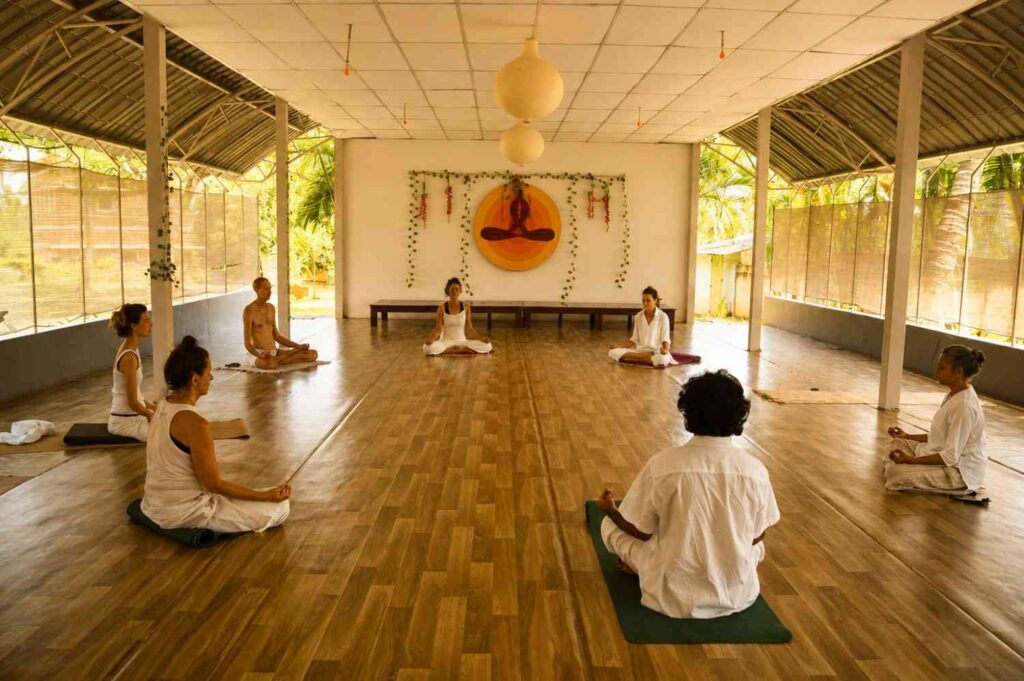
Guided meditation practice at Yoga hall, Yoga Gita Ashram.
The simplest way to understand the difference is:
- 200-hour Yoga Teacher Training = Foundation
- 300-hour Yoga Teacher Training = Advanced exploration and deepening
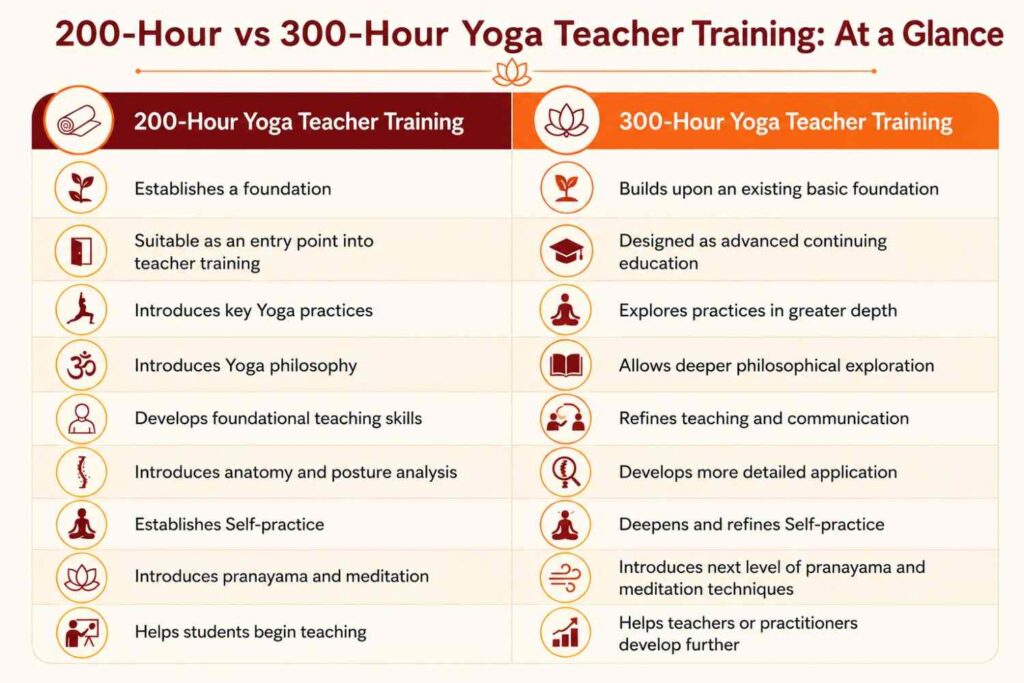
A 200-hour course introduces you to the essential dimensions of Yoga and helps you establish a personal practice while developing the skills required to begin teaching.
A 300-hour course assumes that this foundation already exists. Instead of starting from the beginning, you revisit and deepen what you have learned while exploring more subtle practices, more complex teaching situations, deeper philosophy, and develop greater Self-awareness.
Yoga Alliance describes a 300-hour advanced training in a similar way: it is designed to build upon and deepen the fundamental concepts generally taught at the 200-hour level, and includes more advanced, detailed, and/or subtle principles and techniques.
What is a 200-hour Yoga teacher training course?
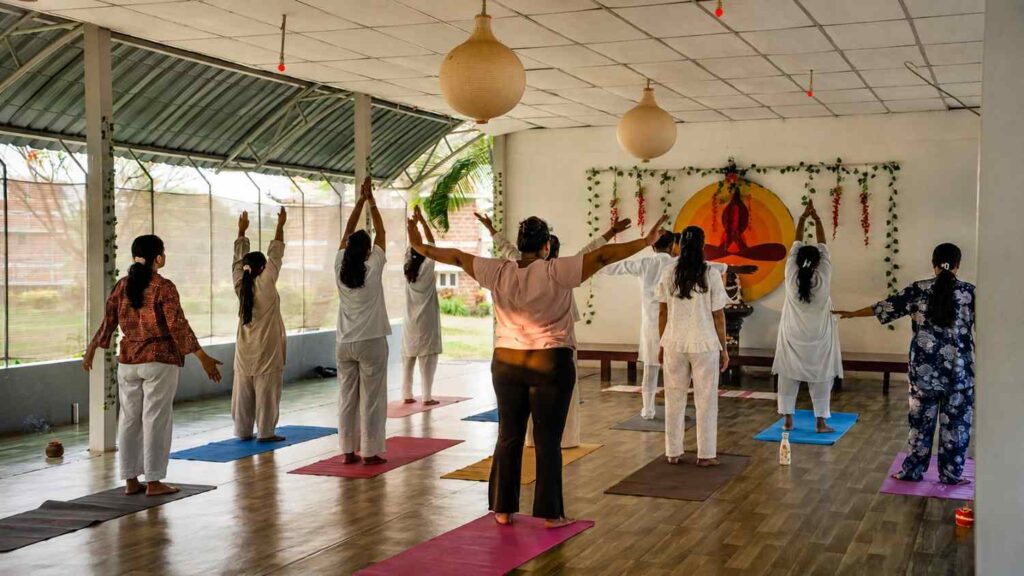
Morning asana practice at Yoga Gita Ashram
A 200-hour Yoga Teacher Training is generally considered the foundational level of professional Yoga teacher education.
It is designed to give students a broad understanding of Yoga rather than focusing only on Asana.
A comprehensive 200-hour programme can include:
- Asana
- Pranayama
- Meditation
- Yoga philosophy
- Yogic anatomy
- Posture analysis
- Teaching methodology
- Sanskrit chanting
- Karma Yoga
- Self-practice / study
At Yoga Gita Ashram, these subjects are not treated as completely separate areas. The programme brings together practice, philosophy, self-study, and daily living so that students can begin to understand Yoga as something that extends beyond the yoga mat.
The purpose is to establish a foundation.
You begin to understand what Yoga is, how to practise it, and how to share it with others.
What is a 300-hour Yoga teacher training course?
A 300-hour Yoga Teacher Training is an advanced training intended to deepen an existing foundation.
Instead, students revisit familiar subjects with a deeper understanding. They are also introduced to new asanas, deeper pranayama practices, and more advanced guided meditations. With some teaching experience, they can also learn to refine their teaching and adapt it to different groups of students
Yoga Gita describes its 300-hour training as a journey towards subtler dimensions of Yoga, where practices require more ability to be still, to witness and a constant Self-reflection.
This is an important distinction.
Advanced Yoga does not simply mean more difficult Yoga.
It can also mean a deeper level of awareness within what you are already practising.
Difference in teaching skills
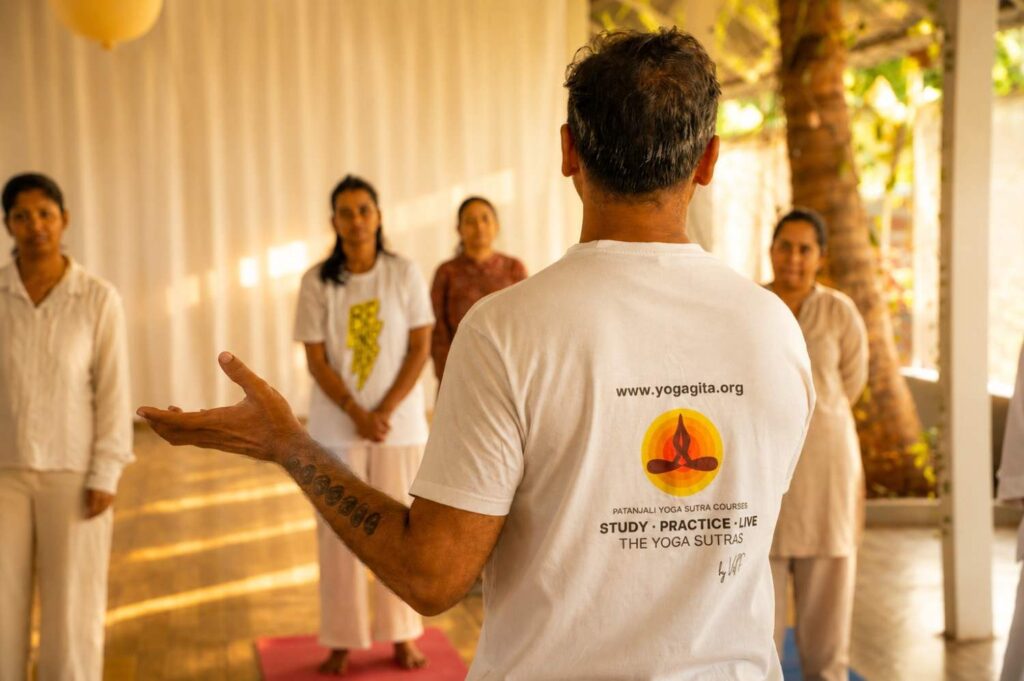
Explanation of yogic priniciples as the base of Yoga self-practice
A 200-hour course gives you the foundation to begin sharing Yoga with others. You learn how to structure a class, guide students through asanas, communicate clearly, and create a balanced practice.
But teaching Yoga is not something we fully learn from books or training alone. It continues to grow through experience, observation, and the people we meet along the way.
When you begin teaching, every student teaches you something in return. One may need a gentle modification, another may need clearer guidance, while someone else may be physically able to practise a posture but may not feel comfortable going deeper. Slowly, you learn to see these differences, listen more carefully, and meet each student where they are.
This is where a 300-hour training can offer a deeper layer of learning. Instead of focusing only on what to teach, you begin to understand how to teach with greater awareness and sensitivity.
At Yoga Gita, the advanced training encourages teachers to connect more deeply with their students, communicate with clarity, adapt their knowledge to different groups, and develop the confidence to share Yoga through classes and workshops.
Ultimately, teaching Yoga is not only about guiding someone through a practice. It is about creating a space where each student feels seen, supported, and gently guided on their own journey.
Difference in self-practice
Perhaps the biggest difference is not something that can be measured by a syllabus. It is the relationship you develop with your own practice.
A 200-hour training can help you establish a regular Self-practice. You begin learning how to practise without depending entirely on a teacher or a group class.
The 300-hour journey can take this further.You may begin noticing subtler patterns in your body, breath, mind, and behaviour. You may become more curious about why you practise in a particular way.
And you may begin to understand that Self-practice is not only about what happens during your time on the mat. It can influence the way you move through the rest of your life.
This connection between the practice and everyday living is central to Yoga Gita’s approach.
Do you need to complete a 200-hour course before a 300-hour course?
A 300-hour training is designed as advanced education that builds upon the foundation generally established at the 200-hour level. For most students, the natural progression is therefore:
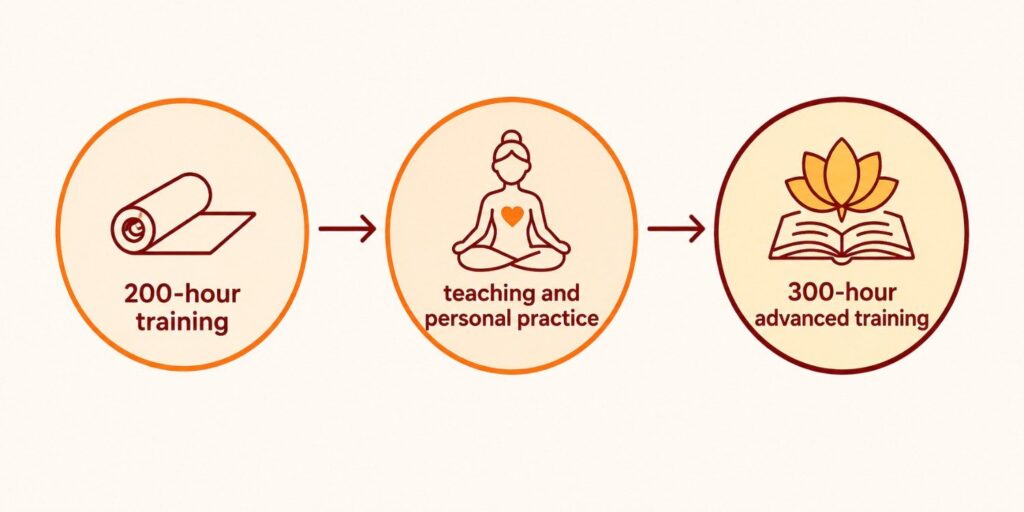
This allows you to gain experience before entering advanced study. That experience can be extremely valuable. After teaching and practising for some time, you return to advanced training with different questions.
You no longer learn only for the theory; have experiences to reflect upon; have taught already some students; and might have discovered areas you want to improve. The 300-hour training can then meet you at a different point in your journey.
You now bring practical experience into your learning; you now have real experiences to reflect upon, having taught different students, faced challenges, and discovered areas where you would like to improve.
Can a Beginner Join a 300-Hour Yoga Teacher Training?
Generally, a 300-hour course is not the ideal starting point for someone who is completely new to Yoga teacher training.
The purpose of advanced training is to deepen an existing foundation.
If you are new to Yoga or have never completed teacher training, a 200-hour course is usually the more appropriate starting point. However, if you have had many years of spiritual / conscious way of living without teaching it, still the 300-hours could be a fit when it aligns to a journey of subtleness.
Yoga Gita’s own programme structure reflects this progression: its 200-hour training is presented as the foundation, while the 300-hour course is described as the next step after being introduced to Yoga.
Starting with the foundation does not mean you are starting small.
It means you are giving yourself the time to build something strong.
Which Course Should You Choose?
The answer depends largely on where you are in your Yoga journey.
You may want to consider a 200-hour course if you:
- Are new to Yoga teacher training & wish to learn how to teach Yoga
- Intend to build a strong foundation
- Are into understanding the different dimensions of Yoga
- Wish to establish a personal Self-practice
- Want to explore Yoga philosophy
- Want to deepen your own practice, even if teaching is not your main goal
Yoga Gita’s 200-hour programme is designed for both people who aspire to teach and those who want to deepen their personal practice.
A 300-hour course may be the natural next step if you:
- Have already completed a foundational teacher training
- Have experience with regular Yoga / meditation practice
- Aim to deepen your understanding
- Are ready to refine your teaching skills
- Are eager to explore more subtle practices
- Want to study Yoga philosophy more deeply
- Want to develop greater Self-awareness
- You feel that you are ready to move beyond the foundations
At Yoga Gita, the 300-hour programme is intended for students who want to deepen their practice, understand the connection between Yoga and daily life, and develop practical tools for continued Self-practice and teaching.
Is the 300-Hour Course More Difficult?
It can be more demanding, but “more difficult” is not always the right way to describe it. But the real challenge can be the level of awareness required.
These are two very different kinds of challenges.
The second one can be surprisingly powerful.
Is a 300-Hour Course Worth It After 200 Hours?
For many teachers and practitioners, a 300-hour course can be a meaningful next step. However, there is no need to rush into advanced training simply because you have completed 200 hours.
Take time to practise, teach if you wish, and observe your own journey.
Notice what you understand and where you still have questions. When you feel ready, advanced training can help you explore Yoga with greater depth and clarity.
The purpose is not to collect certificates one after another, but to give yourself the time and space for your understanding of Yoga to continue unfolding.
Final Thoughts
The difference between a 200-hour and 300-hour Yoga Teacher Training Course is ultimately a difference in stage and depth, rather than simply a difference in the number of hours.
The 200-hour course establishes a foundation in Yoga, helping you develop your practice, understand its philosophical roots, and learn the essential skills required to share Yoga with others.
The 300-hour course builds upon that foundation.
It invites you to explore familiar practices more deeply, develop greater awareness, refine your teaching, and move towards subtler dimensions of Yoga.
At Yoga Gita, this progression is approached as a journey of continued evolution — from establishing a foundation to exploring greater subtlety, awareness, and Self-reflection.
So, rather than asking:
“Which course is better?”
Perhaps the better question is:
“Where am I on my Yoga journey, and what do I need to explore next?”
Yoga does not ask us to rush towards the next level.
It invites us to become present with where we are.
And when we are ready, to take the next step with awareness.


